How to Live Through a Major Home Remodel Without Losing Your Mind
How to Live Through a Major Home Remodel Without Losing Your Mind
So you're planning a major remodel, and you've decided to stay in the house during construction. Maybe you want to save on rent. Maybe moving isn't practical. Or maybe you just didn't realize what you were signing up for.
No judgment. Living through a remodel is one of the most disruptive things a homeowner can do. But with the right preparation, it's also completely manageable — and a lot of homeowners walk away from the experience surprised by how smooth it actually went.
Here's how to set yourself up for sanity, not chaos — before the first hammer swings.
Accept What's About to Happen
Let's get this out of the way early: living in your home during a remodel is going to be inconvenient. There will be dust — like, a lot of dust. There will be noise starting at 7 or 8 AM. Your routines will get disrupted. Your kitchen might not be a kitchen for weeks. Your bathroom might become the one bathroom.
The homeowners who struggle most during a remodel are the ones who expect things to feel normal. They won't. Normal is temporarily off the table — and that's okay. The goal isn't to pretend everything's fine. The goal is to plan around the disruption so it's tolerable instead of miserable.
Map Out Your Construction Zones
Before demolition begins, sit down with your contractor and get a clear sequence of how the project will move through your home. Which rooms are going to be worked on when? Which spaces will be inaccessible, and for how long?
This matters more than people realize. If you know your kitchen is going to be out of commission for three weeks in month two, you can plan ahead. You can set up a temporary kitchen in the garage with a microwave, mini fridge, and coffee maker. You can stock up on slow groceries before the demo starts.
If you know the only bathroom will be down for a week, you can plan to use a neighbor's or rent a small portable unit for that window.
The surprise is what kills you. The planning is what saves you.
Create Your Dust Plan
Dust will spread through your home in ways you don't expect. It migrates through HVAC systems. It settles on floors you thought were far from the work. It gets into closets, drawers, and onto your clothes.
Here's what actually works:
-
Seal off the construction zone — heavy-duty plastic sheeting taped at the ceiling and floor, zippered closures for doors. Your contractor should handle this, but check that it's done properly.
-
Cover your vents — if the construction area shares HVAC with the rest of the house, cover the supply and return vents in that zone to keep dust from circulating. (You'll need to uncover them eventually — ask your contractor whether it's safe to leave them closed during the project.)
-
Change your HVAC filter often — plan to swap the filter every couple of weeks during active demolition. It's cheap insurance.
-
Protect your floors — rosin paper or floor protection boards on any pathways workers will use through the house.
-
Move your stuff — anything you care about, move it out of the construction zone and out of the path. Pack it in boxes and move it to a bedroom or garage. This is also a great time to declutter.
Establish Your New Daily Rhythm
A remodel disrupts your schedule whether you plan for it or not. But you can build a new rhythm around it.
If workers are arriving at 7 AM, plan your mornings accordingly. Get your shower in before they start. Make coffee early. Have your work-from-home setup in a room far from the construction zone.
If you have kids or pets, this is especially important. Kids will need a quiet space for homework and downtime. Pets may need a safe, contained area away from the work — or even a week with a friend or family member during the loudest phases.
Keep a Fallback Space in Your Back Pocket
Even with the best planning, there will be days when living in the construction zone just isn't workable. Maybe it's the day the drywall goes up. Maybe your only bathroom plumbing is being roughed in. Maybe you just need a break.
Have a plan for those days. It could be a friend's house for the afternoon, a coworking space, or even a couple of nights at a budget hotel during the most intense week. You don't need a long-term backup plan — you need a just in case option. Knowing you have one relieves the pressure when it gets to be a lot.
Communicate Like a Grown-Up
The single biggest factor in living through a remodel successfully? Communication with your contractor.
Before the project starts, agree on:
-
Daily check-in time — a quick 5-minute conversation at the end of the day to review what happened and what's coming next. This eliminates surprises.
-
Loud work warnings — ask your contractor to give you a heads-up before especially noisy or disruptive phases. You can plan around them.
-
Access and boundaries — which parts of the house are okay for workers to use (bathroom, entrances) and which are off-limits.
You don't need to micromanage. But you do need a rhythm for staying informed. The remodels that go sideways usually go sideways because the homeowner felt out of the loop, not because something went wrong.
Protect What You Can Control
A remodel will temporarily shrink your usable space. Lean into it. Instead of fighting the disruption, reduce your load:
- Simplify your cooking — sheet pan meals, slow cooker recipes, and takeout are your friends for a few weeks.
- Park your car outside if your garage becomes a staging area.
- Postpone big entertaining plans — a remodel isn't the time to host Thanksgiving.
- Keep a sense of humor about it. Seriously. The ability to laugh at the ridiculousness of it — the noise, the plastic sheeting, the fact that you're brushing your teeth in the kitchen sink — is a genuine survival tool.
It's Temporary
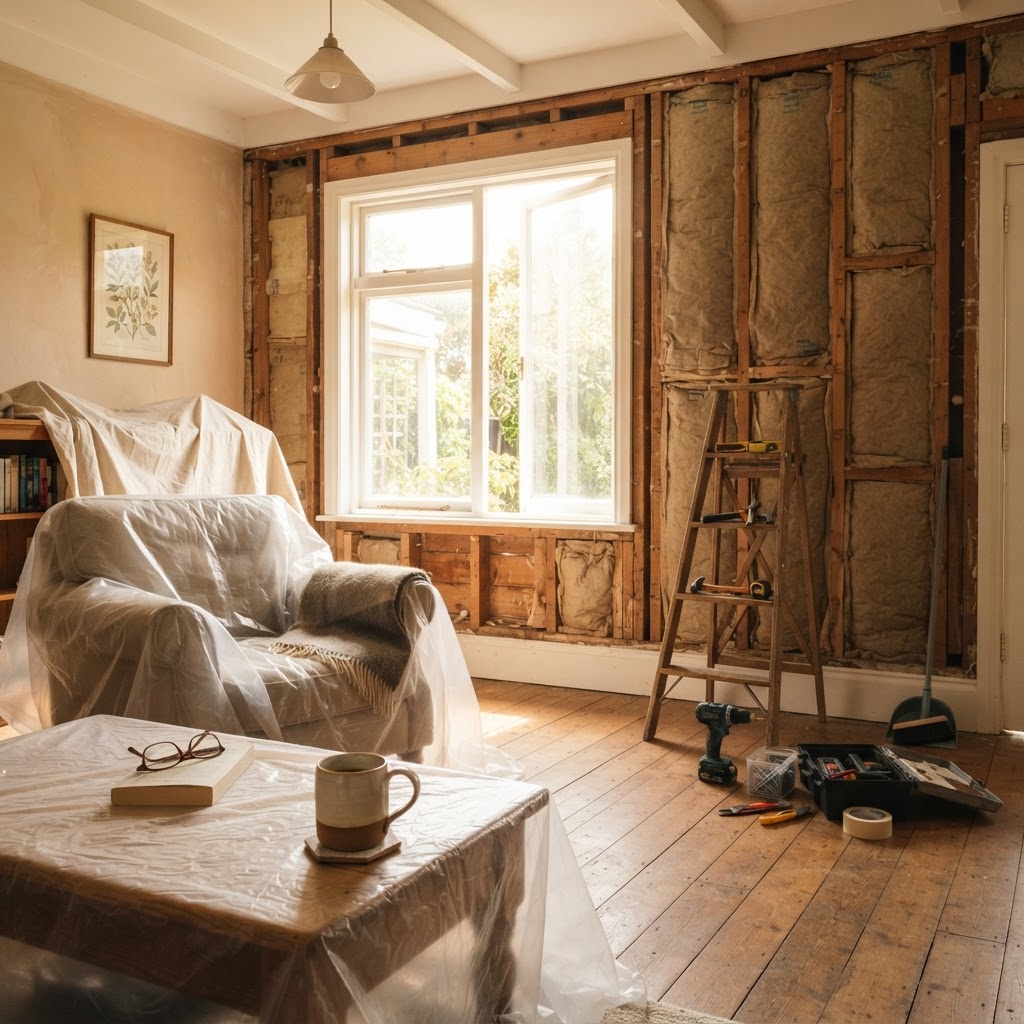
Here's the thing that's easy to forget when you're standing in your living room surrounded by plastic sheeting: it's temporary.
The dust settles. The noise stops. The workers go home. And eventually — sooner than you think — you're standing in a brand-new kitchen, or a gorgeous new bathroom, or a spacious new room that wasn't there before. And the weeks of inconvenience fade into a story you tell about the project.
Living through a remodel is a chapter, not the whole book. Prepare well, communicate with your contractor, keep your sense of humor, and you'll come out the other side with a home you love — minus the war stories that come with winging it.
And if you're planning a remodel and want a contractor who treats your home — and your sanity — with respect, we'd love to talk. That's kind of our thing.